Building documented on the site by 1824; licensed grocery and wine trade recorded at No. 94 in 1903 · Overhaugh Street · Galashiels Conservation Area
An early shop-house with an unusually well-documented commercial life: a family grocery and wine-and-spirit business, later Victoria Wine and subsequently a computer shop. Its domestic accommodation, rear range and cobbled working yard preserve the close relationship between trade and home.
Quick Facts
| Date / main phases | Building documented on the plot by 1824; rear expansion in the later nineteenth century; later shopfront alterations |
|---|---|
| Location | 94–96 Overhaugh Street, Galashiels |
| Building type | Shop or commercial premises with domestic accommodation above |
| Recorded uses | Family grocer and licensed wine-and-spirit merchant; later Victoria Wine; subsequently computer retail and services |
| Recorded occupier | Mrs J. Taket, listed at 94 Overhaugh Street in 1903 |
| Designation | Apparently unlisted; within the Galashiels Conservation Area |
| Notable survival | Cobbled rear yard, evidence of phased enlargement and the long-standing shop-and-house arrangement |
| Public access | Exterior visible from the street; rear yard is private |
Why It Matters
Galashiels’ built heritage is not confined to churches, mills and prominent public buildings. Ordinary mixed-use properties were fundamental to town life: a business occupied the street level while the proprietor, workers or tenants lived above or behind it. 94–96 Overhaugh Street helps the directory represent that everyday pattern.
The building’s value lies in continuity and accumulated change. A building is shown on this plot on John Wood’s plan of Galashiels in 1824, while later mapping and the surviving rear range indicate enlargement during the nineteenth century. The cobbled yard preserves part of the practical working space behind the commercial frontage.
The Story
Overhaugh Street was formerly known as Cowgate. The town survey published in Historic Galashiels records a broken line of buildings along the route on the Gala estate map of 1795, before the street was absorbed into the growing commercial centre. John Wood’s more detailed 1824 plan shows a building on the plot now occupied by 94–96.
This evidence supports a cautious description of the property as an early nineteenth-century or late Georgian shop-house. It does not prove that every part of the present building dates from 1824. Roof form, wall thickness, chimney position, window proportions, masonry breaks and future documentary research may help distinguish early fabric from later work.
The property was expanded at the rear in the later nineteenth century. That enlargement is part of its story: as Galashiels became more densely built and commercially active, an established street property gained extra domestic, storage or business accommodation rather than being wholly replaced.
The cobbled yard is particularly valuable evidence. Yards accommodated deliveries, storage, access to rear buildings and many of the untidy working activities kept away from the shopfront. Such surfaces are vulnerable to resurfacing and redevelopment, yet they make the operation of a combined shop and house easier to understand.
A Grocery and Wine Shop
Overhaugh Street forms one side of Market Square, which helps to explain an apparent variation in the historic addresses. A J. Taket advertisement in the 1898 Galashiels and Selkirk Almanac and Directory describes the business as a family grocer and tea, wine and spirit merchant at “Market Square”. In the 1903 volume, the classified list of grocers licensed for beer, wines and spirits records “Taket, Mrs J., 94 Overhaugh street”. Taken together with the building’s position, these records identify the Taket business with this shop.

The range of goods named in the advertisement suggests the character of a substantial neighbourhood provision business rather than a narrowly specialised shop. Groceries and tea met everyday household needs, while the licensed wine-and-spirit trade extended its commercial role. Delivery by the firm’s own van, also advertised in 1898, shows that the business served customers beyond those who walked into the shop.
The present owner records that the premises continued as a grocery and wine shop through the first half of the twentieth century. In the 1970s the shop became Victoria Wine, and the domestic house was sold separately from the shop. The commercial unit later became a computer shop. This most recent phase is independently reflected in modern business records for Border Computing and Flash UK at 94 Overhaugh Street.
This continuity gives the building particular social value. It is not simply an early structure: it records how one adaptable shop served changing patterns of town-centre trade over more than a century, while the separation of the house and shop illustrates the gradual loosening of the older link between a proprietor’s workplace and home.
Things to Notice
- The relationship between the shopfront and the domestic upper storey
- The building’s position on the Overhaugh Street side of Market Square
- The roof pitch, chimney positions and window proportions
- Masonry changes that may reveal different building phases
- The depth of the rear range compared with the street frontage
- The surviving cobbled yard as part of the property’s working setting
Significance Scores
These are editorial guide scores for public interpretation, not statutory designations. See how the significance scores are assessed.
| Criterion | Score | Reason |
|---|---|---|
| Architectural Interest | 4/5 | An early shop-house with a readable rear extension and surviving cobbled yard |
| Historical Importance | 4/5 | Documented on the plot by 1824 and associated with the Taket grocery and licensed trade at No. 94 by 1903 |
| Social Significance | 5/5 | Records the changing life of a neighbourhood shop, from family grocery and wine merchant to Victoria Wine and later computer retail |
| Rarity | 3/5 | Potentially scarce in recognisable form, although the fabric requires closer study |
| Townscape / Landscape Contribution | 4/5 | Contributes to the varied traditional frontage of Overhaugh Street |
Uncertainties and Research Notes
- Wood’s plan proves the presence of a building on the plot in 1824; it does not establish the date of every surviving wall, opening or shopfront.
- The later rear enlargement and cobbled yard have been identified through local observation and map comparison. Valuation rolls, title records or building papers may provide a firmer construction date.
- The 1903 directory securely connects Mrs J. Taket and the licensed grocery trade with 94 Overhaugh Street. The detailed twentieth-century sequence, including Victoria Wine and the separation of the shop and house, is recorded from the present owner’s knowledge and could be supplemented by later directories and title records.
- No HES designation specific to 94–96 has been located.
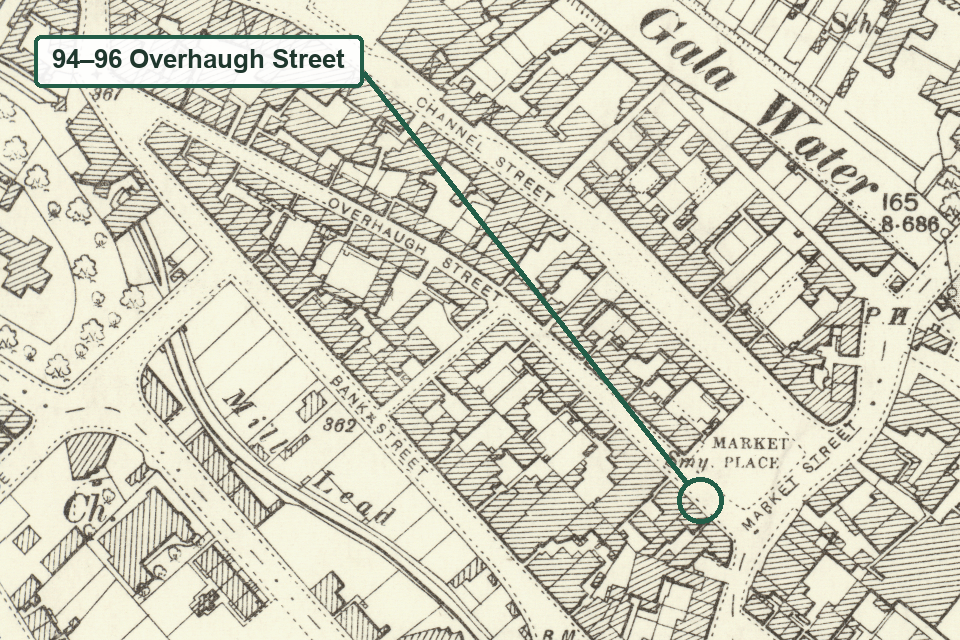
- The 1897 map extract illustrates the later nineteenth-century urban context. It is not the evidence for the building’s presence by 1824.
Image and Licence Notes
The map extract is a static crop from an Ordnance Survey sheet made available by the National Library of Scotland under its stated CC-BY (NLS) reuse terms. It records the site’s late nineteenth-century context, not the present architectural appearance.
The J. Taket advertisement is reproduced from the 1898 Galashiels and Selkirk Almanac and Directory, digitised by the National Library of Scotland and made available through Internet Archive under CC BY-NC-SA 2.5 Scotland. It has been cropped to the advertisement only; its wording and visual content have not been altered. A straight-on present-day photograph and a carefully framed view of the yard would improve this entry later.
Related Places
- Former Salvation Army Citadel, Overhaugh Street
- Bank Street Listed Buildings Group
- Old Cloth Hall, 23 Scott Crescent
- Tea Street Workers’ Housing
Sources
- Historic Environment Scotland / RCAHMS, Historic Galashiels: the archaeological implications of development.
- National Records of Scotland, John Wood, Plan of Galashiels, 1824, RHP82832.
- Ordnance Survey, Selkirkshire Sheet VIII.NW & NE, surveyed 1897 and published 1900, National Library of Scotland.
- National Library of Scotland, The Galashiels & Selkirk Almanac and Directory, 1898, p. 11: J. Taket advertisement.
- National Library of Scotland, The Galashiels & Selkirk Almanac and Directory, 1903, p. 81: Mrs J. Taket listed at 94 Overhaugh Street among grocers licensed for beer, wines and spirits.
- Flash UK contact page, recording the modern computer-related business at 94 Overhaugh Street.
- Building chronology and shop-house separation: information supplied by the present owner, July 2026.