Date: Academy opened on this site in 1910; enlarged in phases; demolished 2024
Location: Melrose Road and Langhaugh Lane
Designation: principal Academy building was not listed
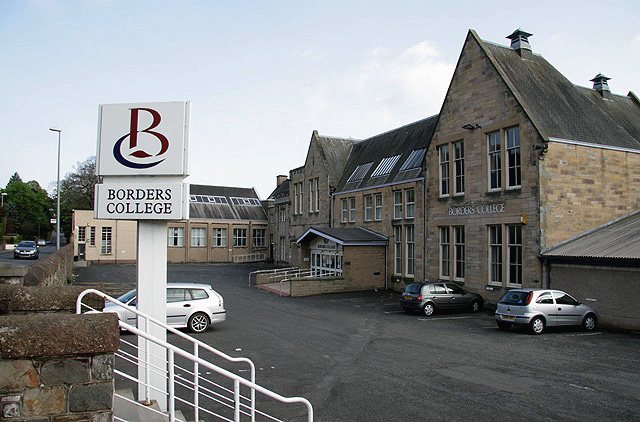
The Melrose Road Academy grew from the conversion of Oaklea into a school in 1910 and served successive generations as Galashiels Academy, a technical college and Borders College before closure and demolition.
Last reviewed: 17 July 2026
Quick Facts
| Date | Academy opened on this site in 1910; enlarged in phases; demolished 2024 |
|---|---|
| Location | Melrose Road and Langhaugh Lane |
| Building type | former secondary school and college |
| Designation | principal Academy building was not listed |
Why the Loss Matters
This was not simply an obsolete institutional block. The site embodied nearly a century of secondary and technical education and contained buildings familiar to thousands of pupils and students. Its demolition removed the principal architectural evidence of that educational sequence, leaving Thorniedean as the strongest historic survivor.
The Story
Local chronology records the opening of a new Academy on 16 December 1910. Planning material and contemporary photographic descriptions explain that the existing house called Oaklea was adapted for school use and that further buildings were added over time. This resolves an apparent conflict with an official report referring broadly to interwar construction: 1910 marks the initial Academy phase, while much of the larger complex resulted from subsequent enlargement.
The Academy moved to the Gala policies in 1964. The Melrose Road site continued in education through Galashiels Technical College and, from 1984, Borders College. College functions transferred to Netherdale in April 2009, after which the buildings stood empty while redevelopment proposals evolved.
The former Academy ranges were demolished in 2024. A good lost-building page should show both the occupied complex and the demolition, while avoiding the implication that listed Thorniedean was lost with it.
Things to Notice in Historic Images
- The earlier domestic core and later educational ranges.
- Large classroom windows and the institutional rhythm of the elevations.
- The relationship with Thorniedean and the Queen’s Centre.
- How the complex filled its sloping site between Melrose Road and Langhaugh Lane.
Significance Scores
| Criterion | Score | Reason |
|---|---|---|
| Architectural interest | 3/5 | A layered institutional complex rather than a single unified design |
| Historical importance | 5/5 | Central to secondary and technical education in Galashiels |
| Social significance | 5/5 | Strong collective memory among former pupils, staff and students |
| Rarity | 3/5 | Its local educational sequence was distinctive even though the buildings were unlisted |
| Townscape contribution | 4/5 | Formerly a major element of the Melrose Road approach |
How the significance scores are assessed
Notes and Uncertainties
The page must distinguish the 1910 opening from later phases and must not describe the whole complex as a single 1910 design. Demolition was photographed in 2024. Thorniedean House survives and requires its own entry.
Sources
- Old Gala Club timeline
- Scottish Borders Council planning committee report, 2008
- Wikimedia Commons: former Academy and Borders College

Image and Licence Note
Former Gala Academy and Borders College buildings at Melrose Road, Walter Baxter, 22 April 2009, CC BY-SA 2.0. A second CC BY-SA image from the same day gives a wider view. Licensed 2024 demolition photographs should be used as supplementary evidence where the relevant file page has been checked.
—