Status: Lost
Date: Opened September 1915; demolished 1984
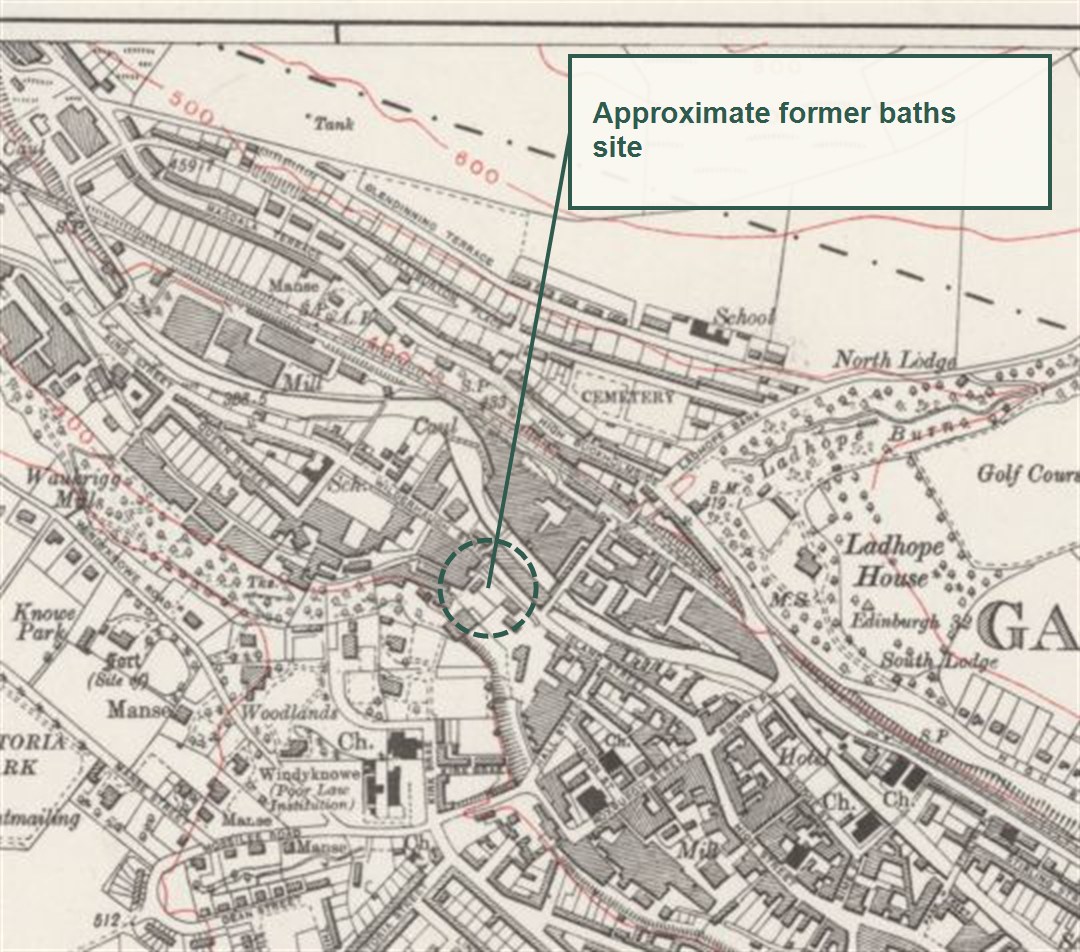
Location: Wilderhaugh, Galashiels; the map below marks the approximate location, not a surveyed building footprint
The former Galashiels Public Baths at Wilderhaugh were an important early twentieth-century recreational and public-health facility. Presented to the town in 1915 by Mr and Mrs A. Anderson Dickson together with a park and children’s playground, the baths served generations of residents and helped establish organised swimming in Galashiels. They were demolished in 1984 after almost seventy years of use.
Quick Facts
| Status | Lost; demolished in 1984 |
|---|---|
| Opening | September 1915 |
| Benefactors | Mr and Mrs A. Anderson Dickson of Westfield |
| Original gift | Swimming bath, park and children’s playground |
| Location | Wilderhaugh, Galashiels |
| Architect | Not identified in the sources consulted |
| Pool dimensions | Not yet confirmed |
| Associated organisation | Galashiels Amateur Swimming Club, founded shortly after the baths opened |
| Demolition | 1984, according to the Old Gala Club chronology |
| Present condition | The baths no longer survive; the map on this page marks their approximate location rather than a surveyed footprint |
A Gift to Galashiels
The clearest contemporary evidence appears in the October 1915 issue of Swimming. It reported that a swimming bath, park and children’s playground had been presented to Galashiels by Mr and Mrs A. Anderson Dickson, describing the combined gift as practical and desirable. Because this report appeared at the time, it provides strong evidence for both the benefactors and the intended relationship between recreation, swimming and public open space.
The Old Gala Club chronology adds the local detail that the public baths and the land for Wilderhaugh Park opened in September 1915. The timing is notable: the facilities were provided during the First World War, when labour, materials and civic attention were under exceptional pressure.
Not a Victorian Pool
The baths are sometimes remembered as Victorian, perhaps because their public-spirited purpose belonged to a tradition established during the nineteenth century. The available evidence, however, dates the Wilderhaugh baths to 1915, fifteen years after Queen Victoria’s death. They should therefore be described as an early twentieth-century public swimming bath unless evidence is found for an earlier facility on the site.
That distinction matters. A correct date places the baths within a later phase of Galashiels’ development, when municipal services, organised recreation and concern for public health were becoming established parts of town life.
Swimming and Community Life
The Old Gala Club records that Galashiels Amateur Swimming Club was founded soon after the baths opened. The facility therefore supported more than informal bathing: it helped create an organised swimming culture, encouraged instruction and provided a setting in which young people could acquire a potentially life-saving skill.
A further documentary trace appears in a 1958 issue of The Borderers’ Chronicle, where the Public Baths, Galashiels, appear among addresses connected with a large fundraising raffle. The reference is slight, but it confirms that the baths remained an identifiable and active part of town life in the mid-twentieth century.
Wilderhaugh and the Changing Town
The pairing of the baths with Wilderhaugh Park and a children’s playground made the gift a small recreational landscape rather than an isolated building. It linked indoor swimming with outdoor play and public open space in an area shaped by the Gala Water, mills, transport routes and later commercial development.
National Records of Scotland catalogues a plan of Wilderhaugh Park incorporating a plan of 1795 and a feuing plan dated 1898. That record predates the baths and may help establish how the ground was divided before the 1915 scheme. It has not been used here to assign an exact building footprint, because the original plan needs to be examined at adequate scale.
Replacement and Demolition
The Old Gala Club chronology records that the replacement Galashiels Swimming Pool at Livingstone Place opened in December 1983 and was formally opened by Princess Anne in July 1984. The same chronology places the demolition of the Wilderhaugh public baths in 1984. The Livingstone Place pool itself later closed and was demolished as part of the new Galashiels Academy community-campus development. A new public 25-metre, six-lane pool within the Academy campus opened on 6 January 2026, continuing public swimming provision close to the Livingstone Place site.
What Was Lost
- A public swimming facility that served Galashiels for almost seventy years
- A tangible expression of local philanthropy by Mr and Mrs A. Anderson Dickson
- An important setting for swimming instruction, recreation and competitive sport
- Part of the historic relationship between Wilderhaugh Park, its playground and the surrounding townscape
- A building remembered by generations who learned to swim or attended the baths
Timeline
- Before 1915: Wilderhaugh Park existed within an area of earlier estate, industrial and recreational development; an 1898 feuing plan survives in the National Records of Scotland.
- September 1915: The public baths and Wilderhaugh Park open following the gift by Mr and Mrs A. Anderson Dickson.
- October 1915: Swimming reports the presentation of the swimming bath, park and children’s playground to Galashiels.
- Shortly after opening: Galashiels Amateur Swimming Club is established.
- 1958: The Public Baths appear in The Borderers’ Chronicle, confirming their continuing place in town life.
- December 1983: The new pool at Livingstone Place opens.
- July 1984: Princess Anne formally opens the new swimming pool.
- 1984: The former public baths at Wilderhaugh are demolished.
- 2026: The Livingstone Place pool is superseded and demolished during development of the new Galashiels Academy campus; a new public pool within the campus opens on 6 January.
Why It Matters
The Wilderhaugh baths tell an important social story. They show how recreation, public health, philanthropy and organised sport became woven into everyday life in twentieth-century Galashiels. Their loss removed more than a swimming pool: it removed a building associated with childhood, instruction, competition and community memory over several generations. Recording the baths also corrects the common impression that they were Victorian and places them securely within the civic development of the First World War period.
Significance Scores
| Criterion | Score | Reason |
|---|---|---|
| Architectural Interest | 2/5 | The baths were a purpose-built public facility, but their architect, design and detailed appearance have not yet been securely documented. |
| Historical Importance | 4/5 | The building represents the development of public recreation, health provision and civic philanthropy in early twentieth-century Galashiels. |
| Social Significance | 5/5 | Generations used the baths for lessons, recreation, club swimming and community activity. |
| Rarity | 3/5 | The building has been demolished, and evidence for the form and operation of comparable Borders facilities is increasingly dependent on archives and personal memory. |
| Townscape Contribution | 3/5 | The baths formed part of the recreational setting of Wilderhaugh Park, although their exact footprint and architectural presence require further research. |
These are retrospective editorial guide scores, not statutory designations. See How the Significance Scores Are Assessed.
Notes and Uncertainties
- Date: The contemporary 1915 report and the Old Gala Club chronology support an opening in September 1915. The baths should not presently be described as Victorian.
- Architect and construction: No reliable source identifying the architect, contractor, materials, pool dimensions or original internal arrangement has yet been located.
- Facilities: The contemporary source confirms a swimming bath but does not establish whether the complex also included slipper baths, laundry facilities, a gymnasium or other services sometimes associated with public baths.
- Location: Wilderhaugh is secure. The annotated 1930 Ordnance Survey map marks the approximate location identified by the site editor, but it should not be read as a surveyed building footprint. Council property records or building plans may allow future refinement.
- Demolition: The year 1984 is supported by the Old Gala Club chronology. The precise closure and demolition dates remain to be checked against council minutes or contemporary newspapers.
- Swimming club: The club is recorded as being founded shortly after the baths opened; a definitive foundation date and early membership record have not yet been verified.
Images and Archive Records
No historic photograph with a clearly verified public-reuse licence was identified during the present research. The map illustration is derived from Ordnance Survey mapping revised in 1930 and published about 1933, supplied online by the National Library of Scotland under CC BY 4.0. The crop and annotation mark an approximate location only. A photograph should not be copied from an archive, social-media page or publication merely because it is visible online.
Sources and Further Reading
- National Library of Scotland, Ordnance Survey, Selkirkshire Sheet VIII.NW & NE – revised 1930 and published about 1933; source of the approximate locator illustration, reproduced under CC BY 4.0.
- Swimming, October 1915 – contemporary notice recording the gift of a swimming bath, park and children’s playground by Mr and Mrs A. Anderson Dickson.
- Old Gala Club, Galashiels timeline – September 1915 opening, establishment of the swimming club, the 1983-84 replacement pool and demolition of the Wilderhaugh baths in 1984.
- The Borderers’ Chronicle, May 1958 – a mid-century reference to the Public Baths, Galashiels.
- National Records of Scotland, RHP142341: Plan of Wilderhaugh Park – plan incorporating earlier mapping and an 1898 feuing plan; consultation may help establish the pre-baths site.
- Douglas M. Campbell, Scottish Baths 1868-1914: And Their Conservation (1993) – broader Scottish context for the development and social purpose of public swimming baths; it does not document the 1915 Galashiels building directly.
- Scottish Borders Council, opening of the new Galashiels Academy campus, 8 January 2026 – records the 6 January opening and the new 25-metre, six-lane swimming pool.
- Live Borders, Galashiels Academy facilities and relocation information – explains the transfer of public swimming provision and redevelopment of the former Livingstone Place pool site.