Status: Lost
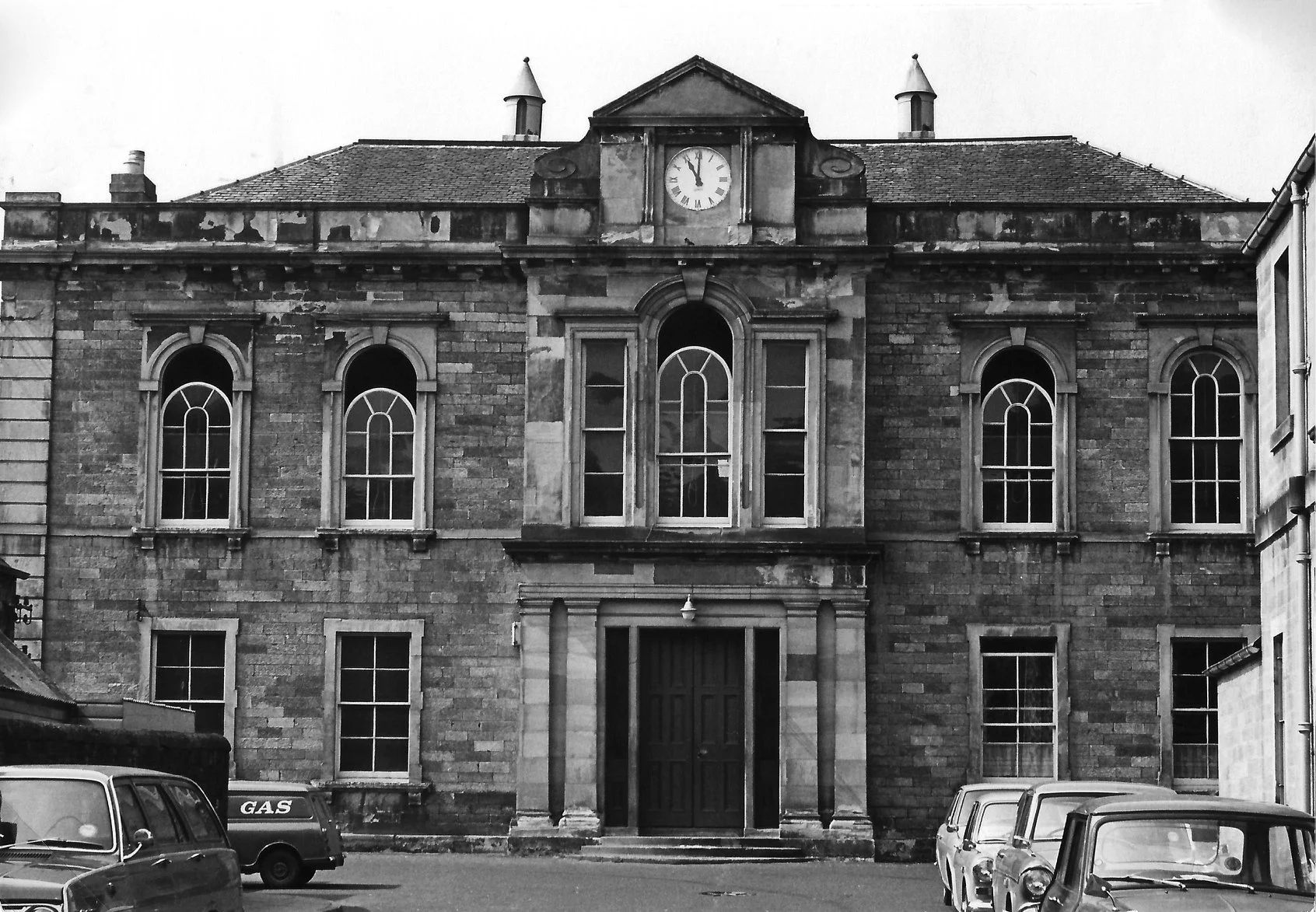
Dates: Public-hall project initiated in 1860; the High Street Town Hall is dated to the 1860s, with 1869 given by the Historic Scotland burgh survey; acquired by the Town Council in 1920; demolished in 1969
Location: High Street, Galashiels, approximately NT 4896 3631
Galashiels Old Town Hall began as a privately promoted public hall before becoming the town’s principal civic and assembly venue. It stood on the High Street during the period when Galashiels was being transformed by textile manufacture into a major industrial burgh. Its demolition in 1969 removed a building that had hosted public meetings, celebrations, performances and important moments in the civic life of the town.
An Important Correction: Town Hall and Corn Exchange
This page was formerly titled “Galashiels Corn Exchange / Old Town Hall”, but the available evidence indicates that the Town Hall and Corn Exchange were separate buildings. Robert Hall’s history records that foundation stones for a Public Hall and a Corn Exchange were laid on the same day, 12 September 1860, by two separate companies. The original proposal had placed both functions beneath one roof, but that arrangement was abandoned.
The joint ceremony, related companies and similar dates make later confusion understandable. Hall describes the procession moving from one foundation-stone ceremony to the other. Contemporary directories also list the Public Hall and Corn Exchange separately, with different management and accommodation. This entry therefore concerns the High Street Public Hall that later became the Town Hall. Hall also places the separate Corn Exchange at the foot of Overhaugh Street, describing Sandy’s Well as standing there “a little below the Corn Exchange”. The Corn Exchange should therefore be treated as a distinct lost building associated with Overhaugh Street, not as another name for the High Street Town Hall.
Quick Facts
| Status | Lost; demolished in 1969 |
|---|---|
| Original function | Public hall and assembly rooms |
| Later function | Galashiels Town Hall |
| Location | High Street, Galashiels |
| Construction | The public-hall project began in 1860; the Historic Scotland burgh survey gives 1869 as the Town Hall construction date |
| Original ownership | Private company |
| Council acquisition | 1920 |
| Main hall capacity | About 600 people, according to a historical town directory |
| Declared inadequate | 1963 |
| Demolished | 1969 |
| Later site use | Incorporated into a High Street car park |
Why Galashiels Needed a Public Hall
By the middle of the 19th century Galashiels had outgrown the institutions of a small settlement. The textile industry was drawing workers, manufacturers and commercial activity into the town, while voluntary societies, political organisations, religious groups and public entertainments all needed large indoor meeting places.
The Public Hall project was a civic response to that growth, although it was initially developed through a private company rather than by the municipal authority. This was a common Victorian model: local subscribers and directors raised capital to erect a hall that could serve public purposes while earning income from lettings.
Robert Hall describes the foundation-stone ceremonies of September 1860 as major public occasions. The procession included the Gala Forest Rifles, dyers and manufacturers, police commissioners, magistrates, bands and representatives from seventeen Masonic lodges. The elaborate ceremony shows how strongly the new hall and corn exchange were associated with civic confidence and the collective identity of industrial Galashiels.
A Large and Flexible Civic Interior
A surviving Galashiels directory describes the Public Hall as accommodating approximately 600 people in its large hall. It also contained separate retiring rooms, a lower room for about 100 people and smaller committee rooms. The combination allowed the building to host large assemblies while supporting the quieter work of organisations and committees.
Historic photographs show a formal public facade suited to a prosperous Victorian town. The building’s architectural effect came from its scale, symmetry and prominent central emphasis rather than from the picturesque Gothic character of many Galashiels churches. It presented public assembly as an important part of urban life.
Trove catalogues a group of drawings connected with the Town Hall, including proposed elevations, alternative schemes, a caretaker’s house and a section through the large hall. The catalogue does not by itself establish the date or authorship of every drawing, but it confirms that useful architectural evidence survives in the national archive.
Public Life Before Municipal Ownership
The hall became a recognised setting for public gatherings long before the Town Council acquired it. One particularly celebrated event was the “Gutterbluid Supper” held on 16 January 1885, bringing together prominent residents and people who had left the town. The curious name drew on a traditional local identity and made the hall a place where Galashiels publicly celebrated itself.
The hall also accommodated meetings, concerts, patriotic events, dinners and organisational business. Its privately owned status did not prevent it from functioning as a town hall in the broader social sense: it was the place where a large section of the community could assemble under one roof.
Purchase by the Town Council
Galashiels had become a parliamentary burgh in the 19th century and already possessed Burgh Chambers for municipal administration. The High Street hall met a different need by supplying a large civic and ceremonial space. In 1920 the Town Council purchased the building from its private owners, formally bringing a long-established public venue into municipal ownership.
The distinction between the Town Hall and the Burgh Chambers is important. The Burgh Chambers housed offices and council functions, while the Town Hall provided the larger assembly space required for public occasions. Galashiels could therefore have both buildings in civic use without their roles being identical.
Ceremony, Performance and Collective Memory
The Town Hall played a role in events that extended beyond routine administration. Local historical records place wartime and charitable gatherings there, and its large room served cultural and social organisations at a time before modern leisure centres and purpose-built conference venues.
One nationally resonant event occurred during the royal visit of 18 July 1947. King George VI, Queen Elizabeth, Princess Elizabeth and Princess Margaret visited Galashiels. The future Queen Elizabeth II and Philip Mountbatten signed the Town Hall visitors’ book together, only months before their marriage. The episode illustrates the ceremonial importance still attached to the building after the Second World War.
From Civic Asset to “Inadequate” Building
By the early 1960s expectations of civic buildings had changed. Administrative requirements, servicing, accessibility, heating and maintenance all placed pressure on older halls. In 1963 the Council declared the Town Hall inadequate for its needs and acquired the Volunteer Hall as an alternative large venue.
The word “inadequate” should be understood as a judgement about contemporary requirements, not proof that the building lacked historical or architectural value. Many Victorian public buildings were lost during this period because adaptation was considered less attractive than replacement, road improvement or clearance.
The Town Hall was demolished in 1969 and the site incorporated into a High Street car park. Its removal coincided with major changes elsewhere in Galashiels, including redevelopment of parts of the Old Town and the closure of the Waverley railway route. A building created to express public confidence was replaced by space for motor vehicles, a concise illustration of changing planning priorities.
What Was Lost
- The town’s principal Victorian public assembly hall
- A High Street landmark associated with the growth of industrial Galashiels
- A large interior capable of holding about 600 people
- Committee rooms and smaller spaces used by civic and voluntary organisations
- The physical setting of celebrations, performances, meetings and royal ceremony
- A visible link between private Victorian enterprise and later municipal ownership
Timeline
- 12 September 1860: Foundation stones are laid for the separate Public Hall and Corn Exchange projects during a major civic procession.
- 1860s: The High Street Public Hall is completed; the Historic Scotland burgh survey gives 1869 for the Town Hall.
- 1885: The celebrated Gutterbluid Supper is held in the hall.
- 1920: Galashiels Town Council purchases the building.
- 1947: The royal party visits; Princess Elizabeth and Philip Mountbatten sign the visitors’ book.
- 1963: The Council declares the Town Hall inadequate and acquires the Volunteer Hall.
- 1969: The Old Town Hall is demolished.
- After 1969: Its site becomes part of a High Street car park.
Why It Matters
The Old Town Hall embodied the public life of Galashiels during its greatest period of growth. It was not simply an administrative building. It offered the large shared room in which the town could debate, celebrate, perform and receive important visitors.
Its demolition also helps explain the present form of the High Street. The car park is not historically empty ground: it occupies the place of a substantial civic landmark. Recovering that memory makes the modern townscape easier to understand and demonstrates how apparently practical planning decisions can remove both architecture and social meaning.
Significance Scores
| Criterion | Score | Reason |
|---|---|---|
| Architectural Interest | 4/5 | A substantial Victorian public hall with a formal High Street facade, large assembly space and documented architectural alterations. |
| Historical Importance | 5/5 | The building embodied the transformation of industrial Galashiels and later served as its principal town hall and civic venue. |
| Social Significance | 5/5 | For more than a century it accommodated meetings, performances, celebrations, royal events and other forms of collective public life. |
| Rarity | 4/5 | It represented a major purpose-built Victorian assembly hall later adapted for municipal use, a building type now lost from central Galashiels. |
| Townscape Contribution | 4/5 | Its prominent civic frontage helped define the High Street; demolition replaced built enclosure with part of a car park. |
These are retrospective editorial guide scores, not statutory designations. See How the Significance Scores Are Assessed.
Notes and Uncertainties
- Construction date: Robert Hall documents the Public Hall and Corn Exchange foundation-stone ceremonies in 1860, while the Historic Scotland burgh survey dates the original High Street Town Hall to 1869. Further work in newspapers, company records and valuation rolls is needed to determine whether 1869 represents completion, alteration or a mistaken later date.
- Separate buildings: The evidence strongly supports treating the Public Hall/Town Hall and Corn Exchange as separate structures. Hall places the Corn Exchange at the foot of Overhaugh Street, while the Public Hall that later became the Town Hall stood on High Street. Further research may refine the Corn Exchange footprint and full use history, but the two buildings should not be conflated.
- Architect: No architect is confidently attributed here. The Trove archive record includes proposed designs, but the catalogue summary alone is insufficient to identify which scheme was built.
- Historic photograph: The surviving page image is retained as an identified local-history photograph. A primary archive reference and confirmed reuse status would strengthen its documentation.
Sources and Further Reading
- Trove, “Galashiels, Town Hall” – NRHE location and related architectural archive.
- Historic Galashiels: Archaeology and Development – construction, purchase, closure and demolition chronology.
- Robert Hall, The History of Galashiels (1898), pp. 132–34 – account of the separate Public Hall and Corn Exchange projects and the 1860 ceremony.
- Galashiels Almanac and Directory – accommodation and management of the Public Hall and separate Corn Exchange.
- Old Gala Club Timeline – public events, council purchase and royal visit chronology.
Explore More
Burgh Chambers and Clock Tower · Volunteer Hall · Return to Lost Buildings