Status: Lost
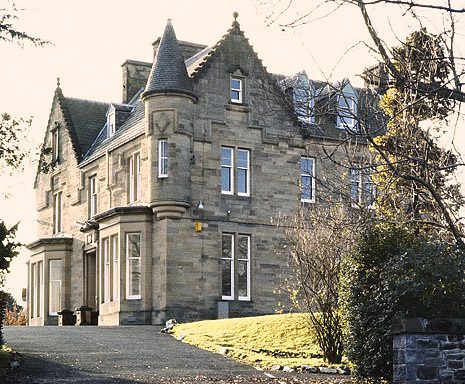
Dates: Nineteenth-century house; hospital from 1933; closed 1987; demolished after closure
Location: Windyknowe Road, Galashiels
Knowepark’s importance lay in two connected histories. It was an architecturally distinctive private house associated with Galashiels’ commercial prosperity, and it later became a place of long-term care for people from across Selkirkshire. Its demolition removed both a notable villa and a setting in which many families experienced illness, ageing, work and care.
Quick Facts
| Status | Lost; demolished after the hospital closed |
|---|---|
| Original building | A substantial private house of nineteenth-century date |
| Known owner | Robert Sanderson, associated with the Galashiels skin trade |
| Public acquisition | Purchased by Selkirk County Council in 1933 |
| Hospital use | Adapted for people described at the time as the chronic sick; latterly a long-stay geriatric hospital |
| Capacity | Recorded as six wards and 31 beds in March 1973 |
| Closure | November 1987 |
| Transfer of patients | Thirty patients moved to the new Borders General Hospital |
| Later use of site | Redeveloped for private housing |
| Date caution | The house’s exact construction date and the year of demolition have not yet been securely verified |
A House Before a Hospital
Knowepark began as a large domestic property rather than as a purpose-built institution. It belonged to Robert Sanderson, whose business was connected with the skin trade. The house therefore formed part of the landscape created by Galashiels’ nineteenth-century commercial and industrial prosperity: substantial homes on rising ground expressed the success of local business families while remaining visually connected to the expanding town below.
The surviving 1987 photograph shows a carefully composed stone villa with bay windows, steep gables and a slender conical-roofed turret. These features gave it a picturesque, almost Scots Baronial character. Set back within mature grounds and approached by a drive, it possessed a strong identity quite unlike the low-density housing that later occupied the site.
Conversion to Public Care
Selkirk County Council acquired Knowepark in 1933 and adapted it for the care of people then described as the chronic sick. The conversion illustrates a recurring pattern in twentieth-century public provision: a large house, no longer required solely as a private residence, could be made to serve an institutional purpose. Domestic rooms and grounds were absorbed into a system of county health and welfare services.
Knowepark was sometimes locally called the “poorhouse”, but that name can mislead. Galashiels had a separate Combination Poorhouse at Windyknowe, built in 1859-60. Knowepark’s history should therefore be described on its own evidence: a former private house acquired by the county council and converted for long-term care.
A Place of Long-Term Care
By March 1973 the hospital had six wards and 31 beds. Its later role was long-stay geriatric care. Buildings of this kind rarely dominate official histories, yet they were intensely significant to patients, relatives, nurses, domestic staff and the wider community. Repeated visits, working routines and long periods of residence gave Knowepark a social meaning that cannot be measured from its architecture alone.
The language used for patients and institutions has changed considerably since 1933. This entry retains historical terms only where needed to explain the record; it does not endorse them. The more enduring point is that Knowepark formed part of the development of collective responsibility for long-term illness and old age.
Closure and Demolition
Knowepark closed in November 1987 as services were reorganised around the new Borders General Hospital at Melrose. Thirty patients were transferred when it closed. The house was subsequently demolished and its grounds developed for private housing. A precise demolition date has not yet been located, so the earlier approximate dates sometimes repeated online should not be treated as settled fact.
The move to a modern hospital may have improved clinical provision, but that functional change is separate from the decision not to retain or adapt the old house. The loss of the building erased a visible chapter of both domestic and healthcare history from Windyknowe Road.
What Was Lost
- A distinctive historic villa: bay windows, steep gables and a turret gave Knowepark an individual silhouette and architectural presence.
- The relationship between house and grounds: the drive, trees and elevated setting were part of how the place was experienced.
- Evidence of adaptive reuse: the building showed how a prosperous private residence became part of public welfare and healthcare provision.
- A place of personal memory: patients, relatives and staff associated the physical building with years of care, work and visiting.
- A layer of the Windyknowe townscape: redevelopment retained the land but not the building that explained its earlier social history.
Why the Loss Matters
Knowepark makes clear that architectural and social significance often reinforce one another. Had it survived only as a villa, it would still have illustrated the domestic ambitions of a prosperous industrial town. Through its hospital use, however, it also became part of a much broader public story about ageing, dependency and care.
Its demolition demonstrates a common weakness in heritage assessment: buildings associated with everyday welfare can be undervalued because they are neither grand monuments nor pleasant subjects. Yet they may hold some of the strongest community memories. Once the place has gone, those memories become harder to locate and explain.
Timeline
- Nineteenth century: Knowepark is built as a substantial private house; the exact date remains to be confirmed.
- Before 1933: the property is associated with Robert Sanderson and the local skin trade.
- 1933: Selkirk County Council acquires the house and converts it for long-term care.
- 1973: the hospital is recorded with six wards and 31 beds.
- November 1987: Knowepark closes and 30 patients transfer to the Borders General Hospital.
- After 1987: the building is demolished and the site is redeveloped for housing.
Significance Scores
| Criterion | Score | Reason |
|---|---|---|
| Architectural Interest | 4/5 | A substantial picturesque stone villa with bays, gables and a distinctive turret. |
| Historical Importance | 4/5 | Connected private industrial-era wealth with the development of county health and welfare provision. |
| Social Significance | 5/5 | A long-term place of care, work and family visiting remembered by many local people. |
| Rarity | 3/5 | Large houses adapted as hospitals were once familiar, but many have since been demolished or radically altered. |
| Townscape Contribution | 4/5 | The house and mature grounds created a strong landmark on rising ground at Windyknowe. |
These are retrospective editorial guide scores, not statutory designations. See the significance scoring methodology.
Notes and Uncertainties
- No secure construction date or architect has yet been identified. “Nineteenth century” is therefore preferable to an unsupported exact year.
- Knowepark Hospital should not be confused with the separate Galashiels Combination Poorhouse at Windyknowe.
- The hospital closed in November 1987. The exact demolition date still requires confirmation from planning, valuation or newspaper records.
- The figure of six wards and 31 beds in 1973, and the transfer of 30 patients in 1987, comes from the contextual information supplied with Walter Baxter’s Geograph photograph.
- Further research in Selkirk County Council and Borders Health Board records may clarify the conversion work, staffing and later alterations.
Sources and Further Reading
Original summary based on the linked records. Source wording has not been reproduced.
- Historic Hospitals, Scottish Borders gazetteer: Knowepark Hospital.
- Walter Baxter, “The former Knowepark Hospital, Galashiels”, Geograph, photographed December 1987.
- Scottish Borders Archive and Local History Centre, Borders Health Board records, GB1097/SBA/4.
- Historic Galashiels: Archaeology and Development, for the separate history of the Galashiels Combination Poorhouse and the wider town.
Explore More
Related places: Galavale House and Lodge, Former Cottage Hospital · Lucy Sanderson Cottage Homes and Ida Hayward Cottages