The surviving Morrison and Murray works are rare evidence of the engineering, storage and support trades that kept Galashiels’ textile mills operating.

Quick Facts
| Date | Mid-to-late nineteenth century, with later links and alterations |
|---|---|
| Location | Roxburgh Street and Botany Lane |
| Building Type | Engineering works and mill-related storage buildings |
| Historic Association | Sanderson and Murray, established in 1844; later Morrison and Murray |
| Construction | Whinstone rubble with sandstone dressings; cast-iron columns and timber floors recorded |
| Listing Status | Category C, HES LB50716 |
| Group Value | Listed group with Botany Mill and the former Glasite Chapel |
Industry Beyond the Mills
Textile manufacture depended on engineers, machinists, storekeepers and repair workers as well as spinners and weavers. The surviving works make that supporting economy visible. Machinery had to be installed and maintained, while wool, skins, components and finished goods required substantial storage.
The buildings are therefore not secondary to the mill story. They demonstrate the web of specialist businesses that allowed large factories to operate and adapt.
Two Historic Blocks
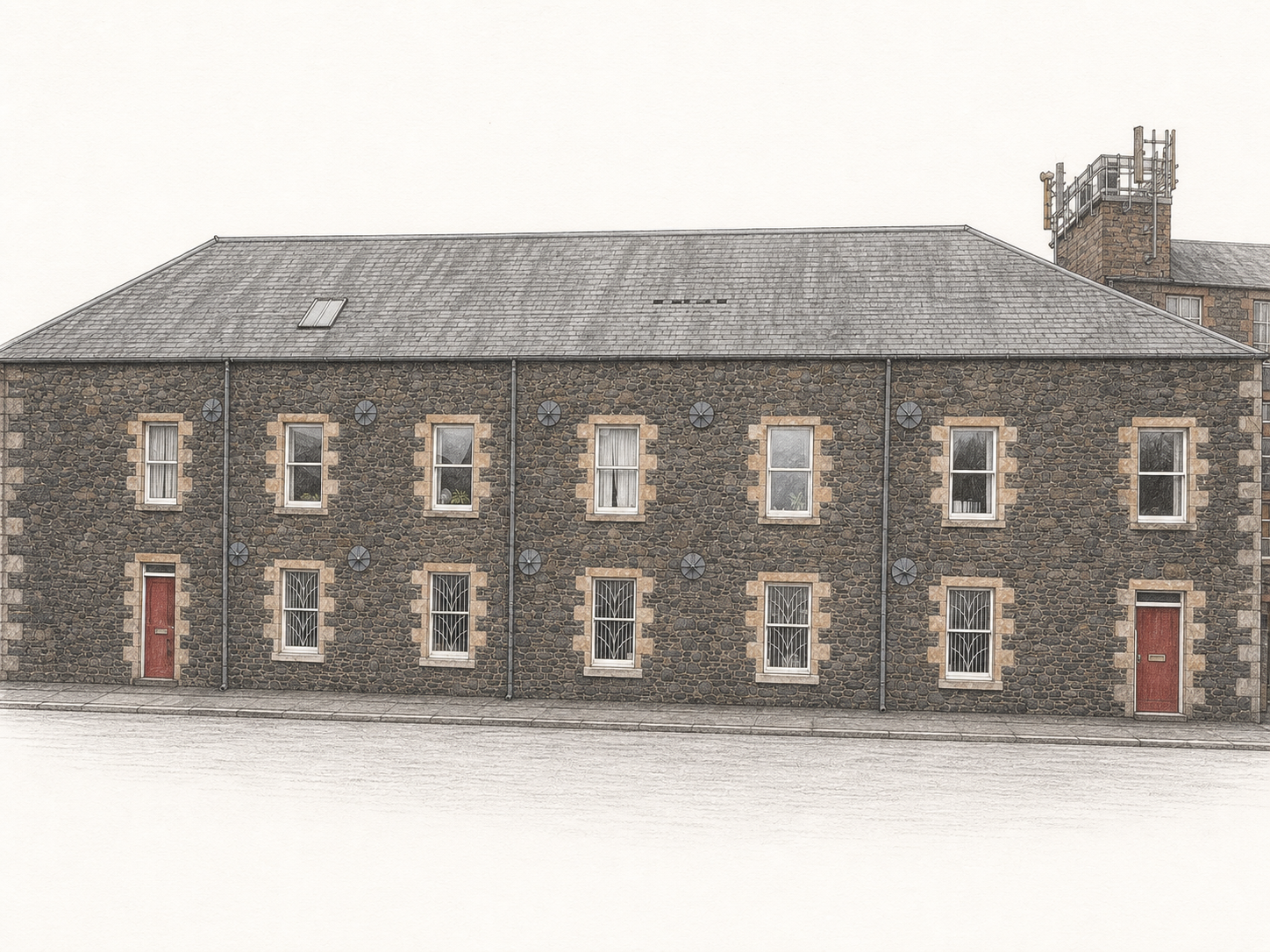
The complex consists of two older buildings joined by a modern link. The Roxburgh Street block is a long single-storey range with a piended roof and regular openings, many later blocked. The Botany Lane block is taller and was suited to storage over several levels.
Whinstone rubble and sandstone dressings connect the works visually with neighbouring industrial buildings. Internal cast-iron columns and timber floors, where they survive, indicate the loads and open working spaces required by industrial use.
Sanderson, Murray and Morrison
HES associates the site with Sanderson and Murray, an engineering business established in 1844, and with the later Morrison and Murray name. The exact sequence of occupation and construction remains to be separated from company records, maps and valuation rolls.
This uncertainty is significant. The listed title is useful, but it should not be assumed that every surviving wall was built at one date or served engineering throughout its life. Some ranges are better understood as storage or wool and skin stores.
The Botany Industrial Group
The works stand beside Botany Mill and the former Glasite Chapel. HES treats them as a group because together they show manufacturing, allied engineering and religious life occupying the same dense industrial quarter.
Blocked openings and later connections record change as businesses expanded, contracted or adopted new processes. The area is best interpreted as a working landscape rather than three isolated monuments.
Things to Notice
- The long, low Roxburgh Street range.
- Blocked windows and doors recording changed industrial circulation.
- The taller Botany Lane storage block.
- Whinstone rubble and contrasting sandstone margins.
- The close physical relationship with Botany Mill and the Glasite Chapel.
Why It Matters Today
These modest-looking ranges are increasingly rare. Their heritage value lies in internal structural systems and functional relationships as much as in the street elevations.
Reuse should retain the differing character of the two blocks and avoid erasing evidence of loading, storage and industrial circulation.
Significance Scores
| Criterion | Score | Reason |
|---|---|---|
| Architectural Interest | 3/5 | Functional industrial ranges whose construction and altered openings clearly express working use. |
| Historical Importance | 4/5 | Evidence of the engineering and storage trades essential to the textile economy. |
| Social Significance | 4/5 | Represents skilled employment beyond the better-known mill occupations. |
| Rarity | 4/5 | Large-scale nineteenth-century industrial storage buildings are increasingly scarce in Galashiels. |
| Townscape Contribution | 4/5 | A key component of the coherent Botany Lane industrial group. |
These are editorial guide scores, not statutory designations. See How We Assess Significance.
Timeline
- 1844: Sanderson and Murray engineering business is established.
- Mid-to-late nineteenth century: The surviving works blocks develop.
- Later nineteenth and twentieth centuries: Engineering and storage uses change; openings and internal connections are altered.
- 2006: The buildings are listed at Category C as part of the Botany group.
Notes and Uncertainties
- The broad date, construction and group value are supported by HES LB50716.
- Company names and building phases require further checking against primary business and property records.
- Current use, interior access and condition have not been inferred from the older designation survey.
Image and Licence Notes
The architectural study above is an interpretive adaptation rather than a measured survey or architect’s drawing. It is derived from the credited CC BY-SA source photograph and is shared under the same licence.
Related Places
Sources
- Historic Environment Scotland, LB50716: Morrison and Murray Engineering Works.
- RCAHMS, Historic Galashiels.
Last reviewed: 15 July 2026.