Status: Lost
Date: Opened in 1875; photographed in 1976; subsequently demolished
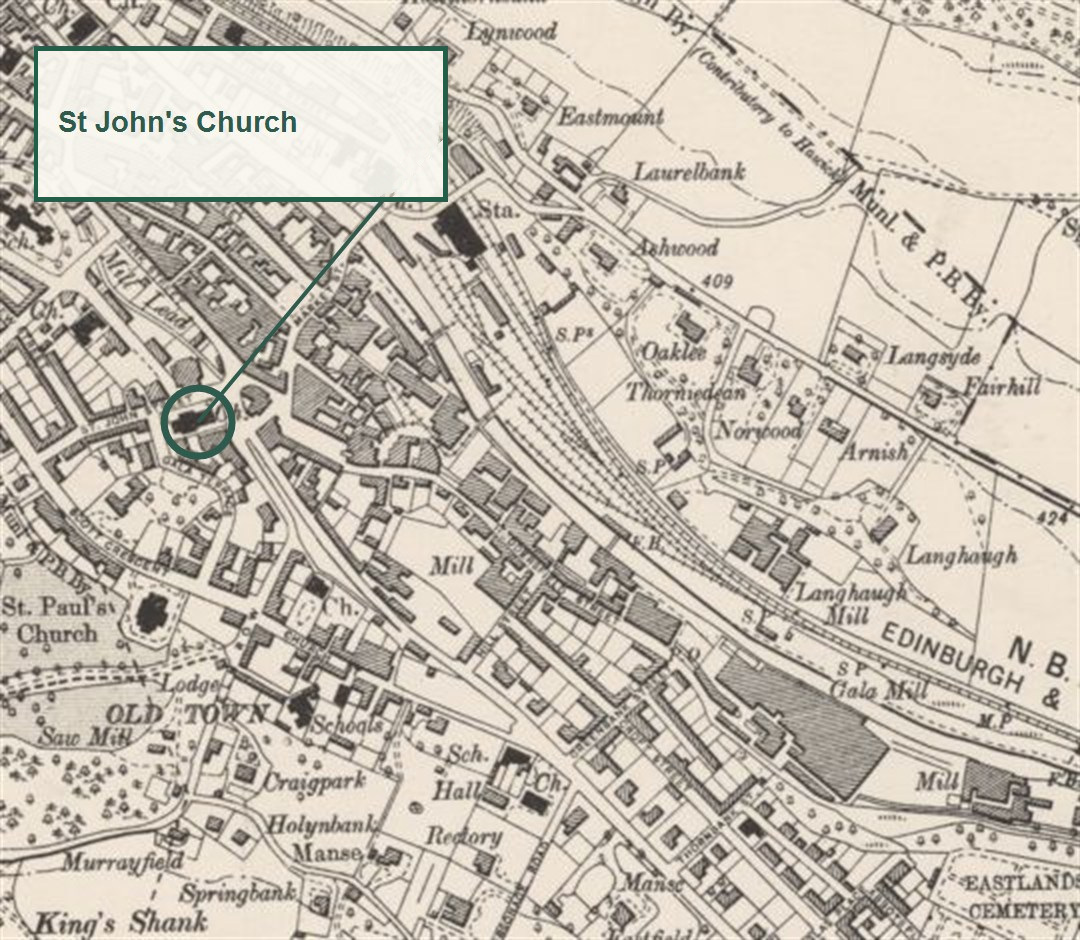
Location: St John Street, Galashiels (NRHE reference NT 4922 3596)
St John’s was a large Victorian Presbyterian church built for the Galashiels Free Church congregation as the textile town expanded. It replaced a smaller 1844 church on the east side of Market Square and later gave its name to a succession of United Free and Church of Scotland congregations. The church has gone, but its story explains both the growth of Victorian Galashiels and the once striking concentration of places of worship around the town centre.
Quick Facts
| Status | Lost; demolished after 1976 |
|---|---|
| Original congregation | Galashiels Free Church |
| Later names | Galashiels St John’s United Free Church; St John’s Church of Scotland |
| Building date | 1875 |
| Builder | Adam Herbertson & Son |
| Architect | Not confirmed in the sources consulted |
| Capacity | About 730 sittings when opened |
| Reported cost | More than £5,000; a contemporary gazetteer gives about £5,150 |
| Historic record | NRHE ID 99776; site number NT43NE 112 |
| Present condition | No church building survives on the recorded site |
A Congregation Born in 1843
The congregation originated in the Disruption of 1843, when ministers and members left the established Church of Scotland to form the Free Church. Robert Hall recorded that the original Galashiels members had belonged to the parish church. Within a year they had called the Reverend Robert Burns Nicol and built a church on the east side of Market Square.
That first Free Church opened on the third Sunday of April 1844. Hall described a building seating 500 people, erected for £500 on a site costing £120. The speed and economy of the project reflect the determination of a newly separated congregation to establish its own permanent place of worship.
The Larger Church of 1875
By the early 1870s the first building was no longer considered adequate. Galashiels had grown dramatically through textile manufacture, and the congregation chose to build anew rather than enlarge the earlier church. Hall states that a new site was acquired and that Adam Herbertson & Son erected the replacement after the Reverend William Whyte Smith arrived in 1873.
The new church opened in 1875. It accommodated about 730 worshippers and cost more than £5,000; Francis Groome’s contemporary Ordnance Gazetteer of Scotland gives the closely comparable figure of about £5,150. These figures show the increased scale and confidence of the congregation: the replacement offered nearly half as many seats again as the 1844 church and cost roughly ten times as much to build.
The national historic-environment record places the church on St John Street at NT 4922 3596. Historic photographs catalogued by Historic Environment Scotland include views from the north-west, east and north-east, taken in 1976. They are especially important because the building no longer survives.
Changing Names and Church Unions
The names attached to the church reflect major changes in Scottish Presbyterian history. The congregation began as Galashiels Free Church. When the Free Church and United Presbyterian Church largely united in 1900, it became Galashiels St John’s United Free Church. Following the reunion of most of the United Free Church with the Church of Scotland in 1929, it was known as St John’s Church of Scotland.
National Records of Scotland catalogues the surviving congregational records under this full sequence of names. The modern St John’s church and hall at Langlee, designed by Wheeler & Sproson and built in 1970-71, carried the name into a new building and a very different post-war setting. The Victorian St John Street church and the Langlee church should therefore be understood as distinct buildings within a connected congregational history.
A Lost Part of the Townscape
The loss matters for more than denominational history. Victorian Galashiels was shaped by a dense pattern of churches, halls, schools and meeting places erected alongside its mills, shops and housing. St John’s represented the confidence and collective effort of one of the congregations created by the upheavals of 1843. Its capacity also demonstrates the scale of churchgoing in a rapidly growing industrial town.
Its disappearance makes the historic relationship between St John Street, Market Square and the surrounding civic and religious buildings harder to read. The surviving Volunteer Hall, Burgh Chambers and library retain part of that wider setting, but the former church is now known chiefly through maps, written records and archival photographs.
What Was Lost
- A substantial 730-seat church associated with the expansion of Victorian Galashiels
- A physical record of the Free Church congregation formed after the Disruption of 1843
- An important element in the historic grouping of churches, halls and civic buildings around St John Street and the town centre
- A building that embodied successive Free Church, United Free Church and Church of Scotland identities
- A familiar setting for worship, education and congregational life over several generations
Timeline
- May 1843: Members leave the parish church at the Disruption and form Galashiels Free Church.
- April 1844: The first Free Church opens on the east side of Market Square.
- 1873: The Reverend William Whyte Smith is settled as minister while plans for a larger church advance.
- 1875: The new church, built by Adam Herbertson & Son for about 730 worshippers, opens.
- 1900: The congregation becomes part of the United Free Church and is subsequently known as St John’s United Free Church.
- 1929: It enters the Church of Scotland as St John’s Church.
- 1970-71: A new St John’s church and hall is built at Langlee.
- 1976: The older St John Street church is photographed for the national collection.
- After 1976: The Victorian church is demolished; the precise year remains to be confirmed.
Why It Matters
St John’s tells a story that cannot be recovered from the surviving Langlee church alone. The two buildings belong to different phases of Galashiels: one to the confidence and denominational variety of the Victorian textile town, the other to post-war expansion and new patterns of community life. Recording the lost church restores an important chapter in the development of St John Street and helps explain why religious buildings once played such a strong part in the town’s skyline and public life.
Significance Scores
| Criterion | Score | Reason |
|---|---|---|
| Architectural Interest | 3/5 | A large purpose-built Victorian church, although its architect and full architectural description have not yet been confirmed. |
| Historical Importance | 4/5 | Closely connected with the Disruption, the growth of Galashiels and successive national Presbyterian unions. |
| Social Significance | 4/5 | A 730-seat place of worship that served a substantial congregation over several generations. |
| Rarity | 2/5 | The building has gone, and its surviving evidential value now rests mainly in records and photographs. |
| Townscape Contribution | 4/5 | It formerly contributed to the notable concentration of religious and civic buildings around St John Street and the town centre. |
These are retrospective editorial guide scores, not statutory designations. See How the Significance Scores Are Assessed.
Notes and Uncertainties
- Demolition date: Historic Environment Scotland catalogues photographs of the church taken in 1976, proving that it still stood then. A reliable source for the precise demolition year has not yet been located.
- Architect: Hall names Adam Herbertson & Son as the firm that erected the 1875 church but does not identify the designer. Builder and architect should not be treated as interchangeable.
- Reported cost: Hall says the church cost more than £5,000; Groome gives about £5,150. Both figures are retained rather than forcing an artificial precision.
- Earlier building: The 1844 church on the east side of Market Square was the congregation’s first permanent church. This page concerns its larger 1875 successor on St John Street.
- Modern St John’s: The surviving 1970-71 church at Langlee is a separate building and has its own Heritage Watch entry.
Images and Archive Records
Historic Environment Scotland’s Trove catalogue preserves four exterior photographs of the church taken in 1976, shortly before the building disappeared. The individual catalogue records can be viewed here:
- View from the north-east (SC 2485603)
- View from the east (SC 2485604)
- View from the north-west (SC 2485605)
- Second view from the north-west (SC 2485606)
These links are provided for research and identification. The photographs are not reproduced here because online access does not itself grant permission to republish them: Historic Environment Scotland requires a separate image-supply and reuse agreement. A licensed copy can be added if publication rights are arranged.
Sources and Further Reading
- Historic Environment Scotland, Trove: Galashiels, St John Street, St John’s Church – NRHE ID 99776, location and 1976 archive photographs.
- Robert Hall, The History of Galashiels (1898), pp. 223-24 – the congregation, first church and 1875 replacement.
- National Records of Scotland, CH3/529 – records of Galashiels Free Church, St John’s United Free Church and St John’s Church of Scotland, 1844-1950.
- Francis H. Groome, Ordnance Gazetteer of Scotland, Galashiels entry – 1875 date and reported cost.
- Scotland’s Churches Trust, St John’s Church, Galashiels – the separate 1970-71 church at Langlee.
- David Leckey, St John’s Church, Galashiels: The First 150 Years (1993) – a locally published congregational history identified through the Open British National Bibliography; consultation would help refine the later chronology.
Explore More
St John’s Church, Langlee · Volunteer Hall · Return to Lost Buildings