Status: Lost
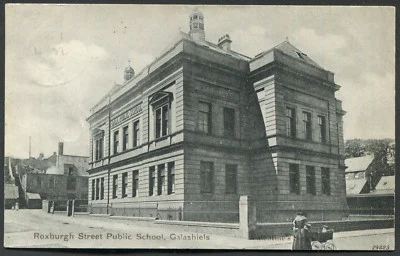
Dates: Built in the early 1890s; exact year reported as 1892 or 1894/95; demolition date not yet verified
Location: Roxburgh Street, Galashiels
Roxburgh Street School was not simply a container for classrooms. It was a substantial public building created during the expansion of state education, a place where technical and art classes also met, and a shared landmark for generations of pupils and families. Its demolition removed one of the most architecturally assertive school buildings in the centre of Galashiels.
Quick Facts
| Status | Lost; the former school has been demolished |
|---|---|
| Construction date | Early 1890s; Historic Galashiels gives 1892, while other local summaries use 1894 or 1895 |
| Location | Roxburgh Street, Galashiels |
| Building type | Burgh school with additional community and evening-class use |
| Educational context | Part of the expansion and reorganisation of schooling after the Education (Scotland) Act 1872 |
| Technical education | Textile and technical classes used the school before moving to Burns Hall |
| Community use | Venue for meetings, including the first official meeting of Galashiels Camera Club in 1934 |
| Later change | Its educational role was superseded as local school provision was reorganised |
| Demolition | The exact closure and demolition dates require confirmation |
A School for a Growing Town
Galashiels expanded rapidly during the nineteenth century as the woollen industry drew workers and families into the town. That growth created an urgent need for schools. The Education (Scotland) Act 1872 established elected school boards and accelerated the provision of public education, turning the school building into one of the defining civic types of late Victorian Scotland.
The official Historic Scotland burgh survey states that an earlier school enterprise was handed to the School Board in 1873 and replaced in 1892 by the building known as Roxburgh Street School. Other local timelines give 1894, while the existing site record had used 1895. Until the original School Board minutes or building papers are checked, the safest description is “early 1890s”, with the differing dates made explicit.
Architecture and Civic Presence
The historic postcard shows a large two-storey stone building with a formal, symmetrical character. Strongly projecting end bays, horizontal courses and rows of tall windows gave it the scale and rhythm of a public institution. Its raised roofline and emphatic corners made the school legible from a distance, while the generous windows expressed the late Victorian concern with light and ventilation in educational buildings.
This architectural confidence mattered. A substantial school told pupils and parents that education was a permanent public responsibility. It also gave Roxburgh Street a civic landmark rather than an anonymous service building. The loss therefore affected the appearance and hierarchy of the street as well as the history of education.
More Than Daytime Schooling
Roxburgh Street School served needs beyond ordinary school hours. The growing technical-education movement used available public buildings before it could afford dedicated premises. Accounts of the textile college’s development record technical classes at Roxburgh Street School in the 1890s, before they moved to Burns Hall and eventually to the purpose-built college in Market Street. The school was thus one link in the chain that led to a nationally important centre of textile education.
It also provided space for voluntary and cultural activity. Galashiels Camera Club records that its first official meeting in 1934 attracted a large attendance at Roxburgh Street School. Such uses show how schools functioned as neighbourhood halls and civic rooms: publicly recognised places where clubs, classes and meetings could gather.
Closure and Demolition
Twentieth-century changes in education brought larger and more specialised facilities. A new Galashiels Academy opened in 1964 and replaced provision associated with the older Roxburgh Street and Melrose Road schools. The precise sequence by which Roxburgh Street School ceased educational use, acquired any interim functions and was demolished has not yet been securely documented in the sources consulted.
That gap should not be concealed by repeating an approximate demolition year as fact. Planning files, School Board or education-authority records, valuation rolls and local newspapers may establish the chronology. What is certain is that the imposing school shown in historic photographs no longer survives.
What Was Lost
- A major Victorian public building: the scale and Classical discipline of the school gave Roxburgh Street a strong civic focus.
- Evidence of educational reform: the building made the expansion of publicly organised schooling visible in the fabric of the town.
- A link in the history of textile education: technical classes met here before specialist premises became available.
- A shared community venue: clubs and local organisations used the school as a recognised place of assembly.
- An anchor for personal memory: classrooms, entrances and playground routines connected former pupils across generations.
Why the Loss Matters
Schools often have unusually deep social significance because large numbers of people encounter them at a formative stage of life. Their architecture becomes part of collective memory: the route to the entrance, the view from a classroom, the sound of circulation spaces and the boundary between playground and street. When the building disappears, a community loses the physical setting through which those memories can be shared.
Roxburgh Street School also demonstrates that apparently ordinary municipal buildings can carry several histories at once. It belonged to the story of compulsory education, the training needs of the woollen industry, voluntary cultural activity and the visual development of Roxburgh Street. No replacement building can reproduce that particular combination.
Timeline
- 1873: an earlier school enterprise is transferred to the School Board, according to the Historic Scotland burgh survey.
- Early 1890s: the replacement building known as Roxburgh Street School is erected; sources differ between 1892 and 1894/95.
- 1890s: technical and textile classes use the school before moving to Burns Hall.
- 1934: Galashiels Camera Club holds its first official meeting in the school.
- 1964: the new Galashiels Academy opens as local secondary provision is reorganised.
- Later twentieth century: Roxburgh Street School is demolished; the exact date remains to be verified.
Significance Scores
| Criterion | Score | Reason |
|---|---|---|
| Architectural Interest | 4/5 | A substantial and formally composed Victorian school with a strong institutional presence. |
| Historical Importance | 4/5 | Represented the expansion of public education and contributed to the early history of technical teaching in Galashiels. |
| Social Significance | 5/5 | Connected generations of pupils, teachers, families, clubs and evening-class students. |
| Rarity | 4/5 | One of the town’s major purpose-built school-board-era buildings, now entirely lost. |
| Townscape Contribution | 4/5 | Its scale and emphatic stone elevations made it a landmark on Roxburgh Street. |
These are retrospective editorial guide scores, not statutory designations. See the significance scoring methodology.
Notes and Uncertainties
- Historic Galashiels gives 1892 for the replacement and naming of Roxburgh Street School. The Old Gala Club timeline places the new school in 1894, while the former page used 1895. The discrepancy is retained until primary records resolve it.
- The exact closure and demolition dates have not yet been verified. “About 1970” should therefore not be presented as settled fact.
- The architect and original accommodation have not yet been identified in a reliable source.
- The postcard demonstrates the building’s exterior form, but its publisher, date and reuse status require further research. It should not be treated as a freely reusable image merely because a copy has appeared for sale online.
- Further research should consult School Board minutes, education records, valuation rolls and planning files.
Sources and Further Reading
Original summary based on the linked records. Source wording has not been reproduced.
- Historic Galashiels: Archaeology and Development, Historic Scotland and Scottish Burgh Survey.
- Old Gala Club, Galashiels timeline.
- Galashiels Camera Club, history of the club.
- Galashiels Heartland, history of the Scottish College of Textiles.
- Heriot-Watt University, history of textile education in Galashiels.
- Walter Baxter, Galashiels Academy, Geograph; contextual note on the schools replaced by the 1964 academy.
Explore More
Related places: Burgh Primary School, Gala Park · Former Galashiels Academy and Borders College