Status: Lost
Date: Mechanised mill erected in 1802 on a site associated with a much older waulking tradition; reportedly demolished in 1949
Location: At or near the foot of old Bank Street, beside the former mill lade and Round Tree Bridge, Galashiels
Waulkmillhead Mill linked two very different phases of Galashiels textile history. Its site has been associated with one of the town’s early waulk or fulling mills, while the documented building erected in 1802 belonged to the new age of mechanised cloth production. Enlarged and supplied by the town’s mill lade, it became part of a network of firms, families and technologies that transformed a small settlement into an industrial town. The mill itself has gone, but the lade, the crossing at Round Tree Bridge and the shape of Bank Street still preserve part of its setting.
Quick Facts
| Status | Lost; the mill was reportedly demolished in 1949 |
|---|---|
| Main documented date | 1802 |
| Earlier site history | Associated by RCAHMS with one of at least two Galashiels waulk-mill sites recorded by the early 1580s |
| Founders in 1802 | John Roberts, George Paterson, James Johnstone and John Lees |
| Function | Fulling or waulking, later expanded mechanised textile production |
| Power | Water from the mill lade, later supplemented by steam |
| Later connections | Dickson, Dobbie & Co.; the Roberts family’s wider Victoria and Bristol Mill interests |
| Present evidence | No mill building survives; the lade setting and Round Tree Bridge remain legible |
| Public access | The surviving streetscape can be viewed from public space; the marker is representative rather than a surveyed mill footprint |
What Was a Waulk Mill?
Waulking, also known as fulling, was an essential stage in making woollen cloth. Woven material was washed and repeatedly worked so that its fibres matted together, producing a denser, stronger and more even fabric. Before mechanisation this could be done by foot. Water-powered fulling stocks transferred the labour to wooden hammers driven by a mill wheel, making a dependable water supply a fundamental part of the industry.
This helps explain both the name Waulkmillhead and the importance of the lade. The mill was not an isolated workshop placed arbitrarily beside Bank Street. It belonged to a connected hydraulic system that drew water through the town and enabled several generations of textile production. Roads, buildings and property boundaries later grew around that infrastructure.
An Older Industrial Site
The earliest history requires careful wording. Historic Galashiels, produced by the Royal Commission on the Ancient and Historical Monuments of Scotland, records that at least two waulk or fulling mills existed in Galashiels by the early 1580s. It associates their locations with the later sites of Mid Mill and Waulkmillhead Mill. This is evidence for an early industrial tradition at or near the site, not proof that any part of the building demolished in the twentieth century dated from the sixteenth century.
Some later accounts also refer to a mill being established here in the seventeenth century. Until the underlying title, estate or burgh records are traced more fully, that phase is best understood as part of the site’s reported development rather than as a securely reconstructed building history. What can be said with confidence is that the place-name and water system preserve a connection with the pre-factory cloth trade.
The Mechanised Mill of 1802
A much firmer point in the chronology comes in 1802, when John Roberts, George Paterson, James Johnstone and John Lees erected a new mill at Waulkmillhead. Historical accounts describe a modest initial installation, containing one set of textile machinery, followed by enlargement as production developed. Water power remained central, but steam was subsequently added, allowing the works to operate with greater capacity and less dependence on water conditions alone.
The date is significant. Galashiels had long made cloth, but around the turn of the nineteenth century scattered craft production was being reorganised around purpose-built mills, machinery and shared power systems. Waulkmillhead belongs to that transition. It was neither simply an ancient fulling shed nor one of the immense later Victorian factories. Its importance lies partly in occupying the ground between those worlds.
Firms, Families and an Expanding Mill Town
By 1857 Arthur Dickson had joined David Dobbie at Waulkmillhead, trading as Dickson, Dobbie & Co. The partnership continued until 1865. Dickson then established Wheatlands Mill, whose national historic-environment record preserves this connection. The movement from one works to another illustrates how Galashiels industry expanded: partnerships were formed and dissolved, experienced manufacturers founded new mills, and knowledge, capital and workers circulated through the town.
The site also became associated with the Roberts family’s wider concerns. Sources connect the Roberts interests at Waulkmillhead with Victoria Mill and, later, Bristol Mill. These links should not be read as a single unchanging company history; ownership and operating arrangements altered over time. They nevertheless show that Waulkmillhead formed part of a broader industrial network rather than surviving as an isolated remnant of the early trade.
A Social Landmark at the Foot of the Street
Robert Hall’s History of Galashiels gives the site a human dimension. In his account, Waulkmillhead was a familiar place near the foot of the old street. A discarded wooden axle from the mill wheel lay against a dyke and provided an informal gathering place where local tradesmen met after work. Hall also associated the vicinity with fairs held before later urban changes altered the setting.
The value of this description is not that every remembered detail can be plotted precisely. It shows that the mill environment was woven into ordinary social life. Industrial structures supplied landmarks, meeting places and the names by which parts of the town were understood. Waulkmillhead was therefore both a place of production and part of Galashiels’ shared geography.
Demolition and the Surviving Setting
The derelict mill is reported to have been demolished in 1949. A fully documented account of its final years, the end of production and the sequence of demolition has not yet been located, so the date is retained as a well-established local-history report rather than presented as the conclusion of a complete building record.
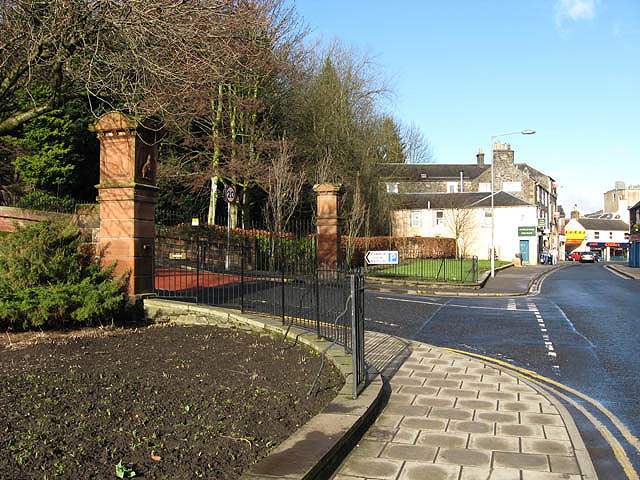
Although the mill has disappeared, its setting has not been erased completely. At the foot of Bank Street Brae, Round Tree Bridge crosses the line of the former Waulkmillhead lade. The red sandstone pillars nearby were erected in 1907 in connection with improvements to Bank Street and were restored in 2000. They mark the bridge approach; they should not be mistaken for the original entrance to Bank Street Gardens. The changes in level around the brae, bridge and former watercourse still help explain why this part of the town looks as it does.
What to Notice
- The crossing at the foot of Bank Street Brae, where Round Tree Bridge passes above the former lade
- The relationship between the street level, the lower watercourse and the steeply rising brae
- The red sandstone pillars erected in 1907 as part of Bank Street improvements
- The surviving line of the lade, which once carried working water through the industrial town
- The absence of the mill itself: later development makes the original industrial setting difficult to imagine without maps and documentary evidence
What Was Lost
- A documented early mechanised mill of 1802 on a site associated with a much older waulking tradition
- Physical evidence for the transition from water-powered fulling to larger, mixed-power textile production
- A building connected with several manufacturers and with the wider expansion of the Galashiels mill network
- A long-standing landmark at the foot of old Bank Street
- A place remembered not only for work but also for informal gathering and community life
Timeline
- By the early 1580s: At least two waulk or fulling mills are recorded in Galashiels; RCAHMS associates one probable site with later Waulkmillhead Mill.
- Seventeenth century: Some secondary accounts report a later mill at the site, but the precise building history remains to be corroborated.
- 1802: John Roberts, George Paterson, James Johnstone and John Lees erect the documented mechanised Waulkmillhead Mill.
- Nineteenth century: The works are enlarged and use both water and steam power.
- 1857: Arthur Dickson joins David Dobbie at Waulkmillhead as Dickson, Dobbie & Co.
- 1865: The Dickson and Dobbie partnership ends; Dickson subsequently develops Wheatlands Mill.
- Later nineteenth century: Waulkmillhead is connected with the Roberts family’s wider textile interests.
- 1907: Red sandstone pillars are erected during improvements to Bank Street beside Round Tree Bridge.
- 1949: The derelict mill is reportedly demolished.
- 2000: The 1907 pillars are restored.
Why It Matters
Waulkmillhead is important less for a fully documented architectural design than for the continuity represented by its site. It connects early fulling, the water-powered infrastructure of the lade, the introduction of textile machinery, the later use of steam, and the growth of interconnected manufacturing firms. Few places in central Galashiels explain so clearly how an old cloth-making settlement became a mechanised mill town.
Recording the lost mill also changes how the surviving streetscape is read. Round Tree Bridge, the pillars and the former lade are not isolated curiosities. They are fragments of an industrial landscape shaped by the need to move water, people and goods through a confined valley. The building has gone, but those fragments still allow part of its story to be recovered.
Significance Scores
| Criterion | Score | Reason |
|---|---|---|
| Architectural Interest | 2/5 | The mill has been demolished and its successive building phases are not yet documented well enough for a confident architectural assessment. |
| Historical Importance | 5/5 | The site connects Galashiels’ early waulking tradition with the documented mechanised mill erected in 1802 and the later factory network. |
| Social Significance | 4/5 | It was both a workplace and a remembered gathering place embedded in the everyday life and vocabulary of the old town. |
| Rarity | 4/5 | The combination of an early recorded industrial association and surviving lade infrastructure provides uncommon evidence for the town’s long textile chronology. |
| Townscape Contribution | 4/5 | Although the building is gone, the lade, Round Tree Bridge and the levels around Bank Street Brae still shape this central part of Galashiels. |
These are retrospective editorial guide scores, not statutory designations. See How the Significance Scores Are Assessed.
Notes and Uncertainties
- Early site history: The national report associates a sixteenth-century waulk-mill site with later Waulkmillhead. It does not establish that the structure demolished in 1949 contained sixteenth-century fabric.
- Seventeenth-century phase: This appears in later accounts, but a securely sourced construction date and building description have not yet been established.
- Fires and rebuilding: Secondary timelines give differing dates and descriptions. No specific fire chronology is adopted here until it can be checked against contemporary newspapers or business records.
- Ownership and closure: Operators and ownership changed over time, and accounts do not agree fully on the final period of production. The Roberts, Victoria and Bristol Mill connections are therefore described as a wider business relationship rather than one uninterrupted ownership sequence.
- Demolition: The year 1949 is reported by the Old Gala Club. A contemporary demolition notice or newspaper account would strengthen the record.
- Map location: The Heritage Map marker identifies the surviving setting at Round Tree Bridge and the former lade. It is not intended as a surveyed outline of the complete mill complex.
Image and Licence Notes
The principal image is Walter Baxter’s Bank Street, Galashiels, taken on 2 March 2008 and licensed under Creative Commons Attribution-ShareAlike 2.0 Generic. It is reproduced without substantive alteration. The photograph shows Round Tree Bridge, Bank Street and the surviving lade setting; it does not show the demolished mill.
Sources and Further Reading
- Royal Commission on the Ancient and Historical Monuments of Scotland, Historic Galashiels – early waulk mills, industrial development and the town’s historic topography.
- Robert Hall, The History of Galashiels (1898), pp. 105–06 and 399 – the old street and gathering place, and the mill’s industrial history.
- The History of the Scottish Border Counties: Roxburgh, Selkirk and Peebles, volume IV – the 1802 founders, machinery, power and Dickson and Dobbie partnership.
- Historic Environment Scotland, Trove: Wheatlands Mill – Arthur Dickson’s work at Waulkmillhead and subsequent move to Wheatlands.
- Old Gala Club, The Owners and Business Affairs of the Galashiels Mills – detailed local research into the relationships between Galashiels manufacturers and mills.
- Old Gala Club, Timeline of Galashiels Textile Mills and Industry – secondary chronology for Waulkmillhead and the wider textile industry; used cautiously where dates conflict.
- Walter Baxter, Bank Street, Galashiels, Geograph image 711398 – modern view, bridge description and precisely recorded photograph location.
Explore More
Gala Mill Lade and Round Tree Bridge · Bank Street Gardens · Bank Street Listed Buildings Group · Bristol Mill · Return to Lost Buildings